A loja já está disponível

Construímos máquinas Workstation AI para websites, agentes de IA e treino de LLM – configure e compre online.

Obter preços para revendedores
Produtos de IA
Laboratórios de IAAgentes OpenAIAgentes ClaudeBot GrokCRM nativo de IA Workstation AIMarketingTodos os produtos
Soluções de IA
IA aplicadaAgentes de IAIA generativaAutomação com IAFormação em IAPacotes de IA para PMELaboratório de IA empresarialWorkstations de IAHardware e software NVIDIAComputação acelerada NVIDIAIA privadaCloud privada de GPUClusters de GPUIA na edgeIA por setor
Serviços de IA
Modernização de plataformasEngenharia digitalFundações de dados e IAOperações autónomasConsultoria de IAAutomação DevOpsCibersegurançaDesenvolvimento de softwareCriação de agentesConfiguração de MLOpsLeasing de GPUCloud privada de GPU
Sobre nós
EmpresaA nossa históriaParceirosHistórias de clientes
Centros de dados de IA
Centros de dados de IACloud privada de GPUClusters de GPULeasing de GPU
Perspetivas sobre IASérie JevLaboratório de benchmarksSeleção de modelos
Notas técnicas
Documentação
Sistema operativo LinuxUbuntuRed Hat Enterprise LinuxSUSE LinuxAlpine LinuxDebian, Rocky e AlmaLinux
Plataformas de IA na cloudAWS e Amazon BedrockGoogle Cloud e Vertex AIMicrosoft Azure e AI FoundryClouds de GPU e marketplaces
Centros de dados de IA privadosPara escritórios de advogadosPara empresas de contabilidadePlataformas on-premisesCloud totalmente protegida
FerramentasRing PromoterJobshout
Notícias
Blogue
Contacte-nosIniciar sessão

Workstations de IA, software de IA multiagente, infraestrutura de GPU e soluções de agentes inteligentes para empresas modernas.

Contacte-nos

Soluções de IA

IA aplicadaAgentes de IAIA generativaAutomação com IAFormação em IAPacotes de IA para PMELaboratório de IA empresarialIA por setor

Produtos

Todos os produtosCRM e ERP nativos de IA Workstation AIMarketingAgentes OpenAIRing PromoterJobshout

Empresa

Sobre nósEmpresaCentros de dados de IAPorquê a WorkstationParceirosHistórias de clientesPreçosContactoTenthMatrix

Recursos

Perspetivas sobre IANotas técnicasDocumentaçãoSistema operativo LinuxPlataformas de IA na cloudCentros de dados de IA privadosBloguePesquisarMapa do site
Escritório na Bélgica
Workstation SRL, Rue Vanderkindere 34, 1180 Uccle, BrusselsBE 0751.518.683Seg – Sex: 9h00 – 18h00 CET
+32 492 45 67 46
Sede no Reino Unido
77-79 Marlowes, Hemel Hempstead HP1 1LFIndicações – saia na junção 20 da M25 (Outer London)N.º de registo da empresa: 11641870Seg – Sex: 9h00 – 18h00 GMT
+44 7515 356 146
Escritório na Índia
#159 Sector 9, Pocket 1, DDA Flats, 110077 Dwarka, New Delhi
+91 98881 98841
Escritório em Taiwan
3F, No. 2-4, Aisi Rd., Ren'ai Dist., Keelung City 200, Taiwan基隆市仁愛區愛四路2之4號3樓Seg – Sex: 9h00 – 18h00, hora de Taiwan (GMT+8)
+886 926 892 701+32 492 45 67 46
Escritório na Estónia
Aleksander Puškini tn 30-25, 20306 Narva, EstoniaSeg - Sex: 9h00 - 18h00, hora da Estónia (EET)
+32 492 45 67 46

© 2000-2026 Balinder Singh Walia. Todos os direitos reservados.

O sítio web Workstation e todo o seu conteúdo, bem como as APIs e plugins associados, são protegidos por direitos de autor de Balinder Singh Walia. balinder.walia@gmail.com

PrivacidadeEliminação de dadosCookiesTermos de serviçoMapa do site

NVIDIA, o logótipo NVIDIA, RTX, RTX PRO, Blackwell, CUDA, NVLink, MGX, Omniverse, Spectrum-X, Quantum, BlueField, DGX e HGX são marcas comerciais e/ou marcas registadas da NVIDIA Corporation nos EUA e noutros países. AMD, o logótipo AMD Arrow, EPYC, Instinct, Ryzen e Threadripper são marcas comerciais da Advanced Micro Devices, Inc. Dell e PowerEdge são marcas comerciais da Dell Inc. ou das suas subsidiárias. Intel e Xeon são marcas comerciais da Intel Corporation ou das suas subsidiárias. AMAX, AceleMax e LiquidMax são marcas comerciais da AMAX Engineering Corporation. Todos os outros nomes de produtos, logótipos e marcas são propriedade dos respetivos proprietários. Utilizamo-los apenas para identificar os produtos que descrevemos, fornecemos ou suportamos; a sua utilização não significa que os respetivos proprietários nos recomendem.

Loading blog...

Início / Blogues
RustPerformanceArchitectureDevOpsAIAutomation

Rust Async Blocking, Rayon & Modern Applications

What “blocking” means in async Rust, when Rayon fits CPU-bound work, and why Rust stays strong for APIs, edge, agents, and CI/CD platforms

Balinder Walia26 de agosto de 20263 min read
Rust async blocking and Rayon for modern applications

Workstation on why Rust stays a first-class choice for modern applications — and what “blocking” really means when you mix Tokio with CPU-heavy work. Inspired by Alice Ryhl’s Async: What is blocking? (Rayon section). Deep dive: long article.

Rust async blocking and Rayon for modern applications

Bottom line. In async Rust, “blocking” means holding a runtime worker away from .await long enough that other tasks starve. Move expensive CPU work off Tokio’s pool — often with Rayon plus a oneshot channel — and keep the async path responsive for APIs, edge proxies, agents, and CI/CD control planes.

Why Rust keeps winning modern application slots

Teams pick Rust when they need memory safety without a GC pause tax, predictable latency under load, and concurrency that the type system helps you get right. That combination shows up everywhere Workstation builds: high-throughput APIs, edge gateways, agent runtimes, and promotion control planes that cannot freeze when a spike of CPU work arrives.

It is not “Rust for everything.” Our Polyglot Benchmarks dashboard and companion posts — blog / article — compare Rust with Go, Bun, JVM stacks, and scripting edges on the same HTTP workloads. Rust often leads on CPU-bound and concurrency-heavy rows; other runtimes win on velocity or edge transforms. The point is evidence, then ADRs.

What “blocking” means in async Rust

Async runtimes (Tokio and friends) swap tasks at .await points. If your task burns milliseconds of CPU or sleeps with std::thread::sleep without awaiting, the worker cannot schedule anyone else on that thread. Locally you might not notice (a few cores hide the bug); in production you run out of workers and latency tails explode.

Rule of thumb from the ecosystem: stay within tens to hundreds of microseconds between awaits for latency-sensitive services — and treat anything longer as work that belongs elsewhere.

When Rayon helps (CPU-bound)

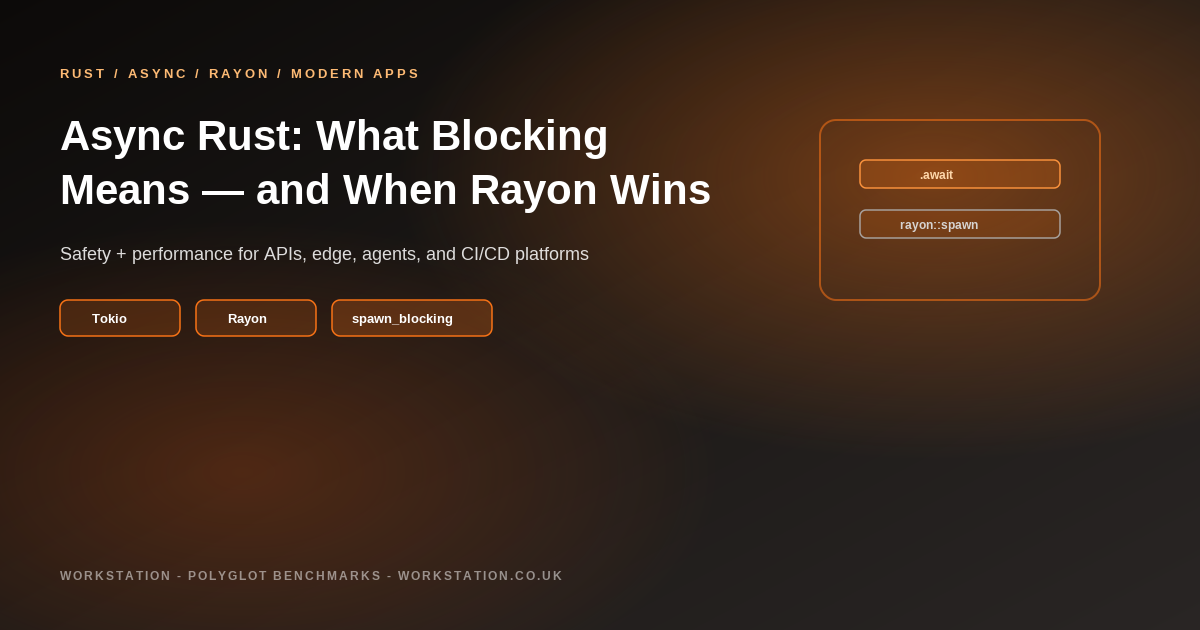
  • spawn_blocking — Tokio’s blocking pool: great for sync IO (filesystem, blocking DB drivers); suboptimal for heavy CPU because it can oversubscribe cores.
  • Rayon — a small, CPU-sized thread pool for parallel iterators and expensive computations. Bridge with rayon::spawn + tokio::sync::oneshot so the async task awaits the result without blocking the runtime thread.
  • Dedicated thread — for forever-loops (connection managers, long-lived workers) that must not permanently consume pool capacity.

That Rayon + oneshot pattern is exactly what Alice Ryhl walks through in the Rayon section — Workstation’s take is how those choices land in polyglot estates shipping agents and platforms, not a reprint of the tutorial.

Where this shows up in Workstation products

  • APIs and edge — keep request workers free for IO; fan CPU transforms onto Rayon when a hot path needs it.
  • Agents — embedding prep, eval batches, and tool-side crunch should not stall the orchestration loop.
  • CI/CD platforms — health checks and promotion engines (see Ring Promoter) stay responsive while heavier verification work runs off-pool.
  • Kubernetes ops — incident copilots like KubePilot need snappy control loops even when analysis is CPU-heavy.

Read next

  1. Long article — cheat sheet, code-shaped patterns, and architecture notes.
  2. polyglot-benchmarks.fictionally.org — live Rust vs peers evidence.
  3. Alice Ryhl — Async: What is blocking?

Published by Workstation.