The AI infrastructure landscape is evolving at breakneck speed. Every team building intelligent applications faces a foundational question: what database underpins your AI stack? The answer determines your query capabilities, your deployment flexibility, your cost structure, and ultimately your ability to iterate on AI features.
This article provides a comprehensive comparison between NebulaDB — an open-source AI-native hybrid database written in Rust — and the emerging category of agent memory platforms (proprietary SaaS services providing persistent memory, context retrieval, and temporal state for AI agents). We examine architecture, features, APIs, deployment, cost, and use cases to help you make an informed decision.
What is NebulaDB?
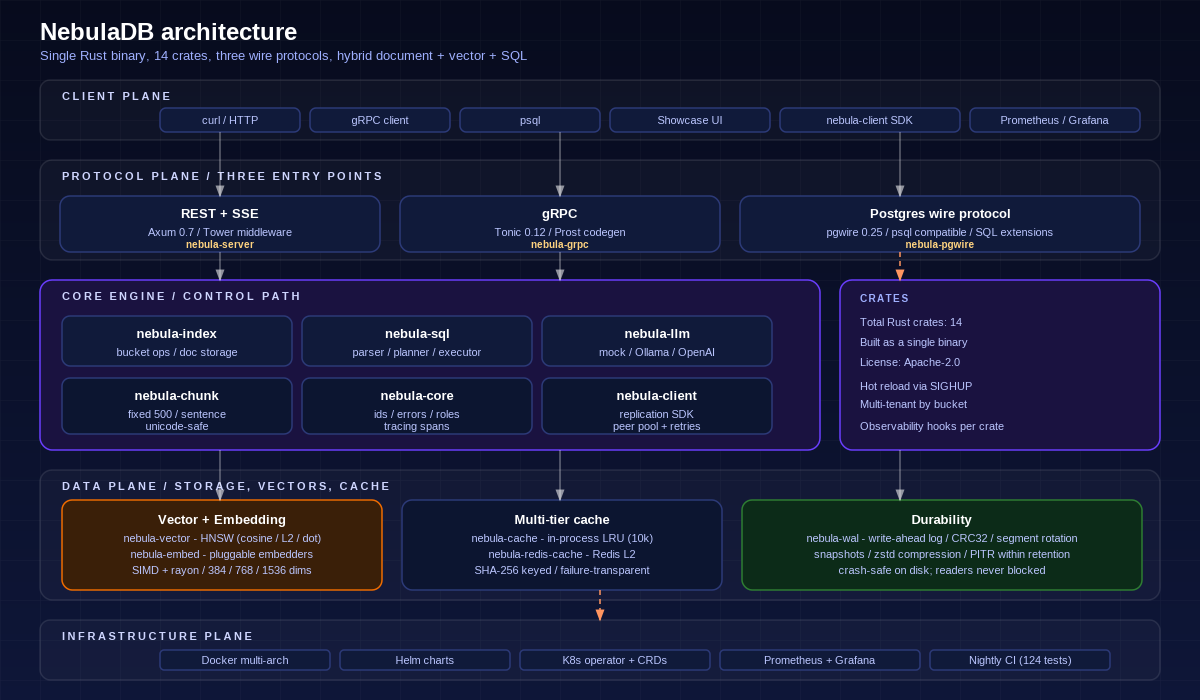
NebulaDB is an AI-native hybrid database that combines document storage, vector search, SQL querying with AI extensions, and streaming Retrieval-Augmented Generation (RAG) — all in a single Rust binary. Licensed under Apache-2.0, it ships as a self-hosted solution with Docker images, Helm charts, and a full Kubernetes Operator with Custom Resource Definitions.
Architecture Highlights
NebulaDB is built as a workspace of 14 Rust crates, each responsible for a distinct capability:
- nebula-server — Main binary, Axum router, Tower middleware (auth, rate limiting, CORS, compression)
- nebula-index — Core TextIndex with bucket-scoped document and chunk storage
- nebula-vector — HNSW graph implementation with cosine, L2 squared, and negative dot-product distances; SIMD-optimized for x86-64 (AVX2) and aarch64 (NEON)
- nebula-sql — SQL parser (sqlparser-rs), planner, and executor with
semantic_match()andvector_distance()functions - nebula-grpc — Tonic-based gRPC services: Document, Search, and AI
- nebula-pgwire — Postgres wire protocol handler (simple query protocol, psql-compatible)
- nebula-wal — Write-ahead log with CRC32 integrity checks, segment rotation, snapshot support, and zstd compression
- nebula-embed — Pluggable embedder trait with Mock and OpenAI-compatible implementations
- nebula-llm — LLM client trait with Mock, Ollama, and OpenAI backends
- nebula-chunk — Document chunking strategies: fixed-size (500 chars, 50-char overlap) and sentence-based
- nebula-cache — In-process LRU embedding cache (10,000 entries default)
- nebula-redis-cache — Redis-backed L2 embedding cache (SHA-256 keyed, failure-transparent)
- nebula-core — Shared types: IDs, NebulaError, NodeRole enum
- nebula-client — SDK for cross-region replication
Three Network Protocols
NebulaDB serves three protocols simultaneously from a single process:
- REST + SSE (Axum 0.7) — Full CRUD, semantic search, SQL queries, streaming RAG with Server-Sent Events, Prometheus metrics, admin operations
- gRPC (Tonic 0.12) — Document, Search, and AI services with streaming RAG
- Postgres Wire Protocol (pgwire 0.25) — Simple query protocol supporting the full SQL dialect including AI extensions; connect with
psql
What are Agent Memory Platforms?
Agent memory platforms are a newer category of proprietary SaaS services designed to provide persistent memory and context infrastructure for AI agents. They typically feature:
- Temporal knowledge graphs — Immutable ledger-based state with versioned history
- Graph traversal — Multi-hop relationship queries rather than similarity-only search
- Shared context layers — Coordination primitives for multi-agent fleets
- Managed infrastructure — Multi-tenant SaaS with enterprise self-host options
- REST APIs and language SDKs — Primary access via HTTP and Python/JS clients
Access is typically invite-based or gated, with pricing ranging from $249/month to $5,000+/month for enterprise tiers. The underlying implementations are closed-source.
Head-to-Head Comparison
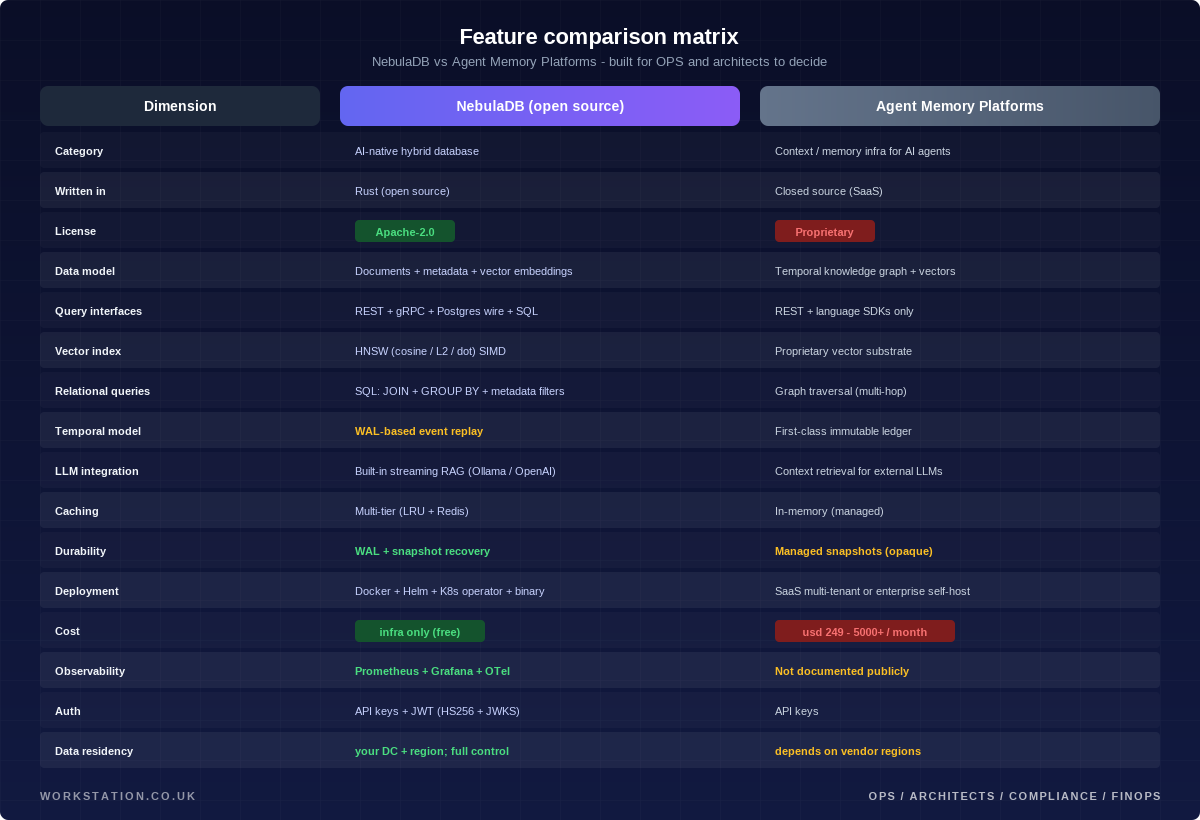
Detailed Dimension Analysis
Data Model
NebulaDB stores documents in buckets with rich metadata (arbitrary JSON) plus vector embeddings. Documents can be chunked server-side with preserved ordering. This model maps naturally to knowledge bases, document corpora, and RAG pipelines where you need to ingest, search, and generate in one system.
Managed platforms typically use a temporal knowledge graph with a vector substrate — optimized for tracking how agent state evolves over time. This model excels at conversational agents that need to remember what a user preferred last month versus now.
Query Interfaces
NebulaDB's four query interfaces (REST, gRPC, Postgres wire, custom SQL) give teams flexibility no managed platform matches. Your data engineers use psql for ad-hoc analytics. Your microservices call gRPC for low-latency search. Your frontend hits REST for streaming RAG. All hit the same index — one bug fix, one feature addition surfaces everywhere.
Managed platforms offer REST APIs and language SDKs — adequate for simple retrieval, but no SQL analytics, no Postgres compatibility, and no gRPC.
Vector Index
NebulaDB implements HNSW (Hierarchical Navigable Small Worlds) from scratch in Rust with three distance metrics (cosine, L2 squared, negative dot-product), SIMD-friendly auto-vectorization, rayon-based parallelism, and soft deletions that preserve graph connectivity. You can inspect and tune the index because it is open-source.
Managed platforms use proprietary vector substrates — you cannot inspect, tune, or understand the retrieval algorithm backing your production system.
SQL with AI Extensions
This is a NebulaDB differentiator with no equivalent in managed platforms. The SQL engine supports:
-- Semantic search with metadata filtering
SELECT * FROM knowledge_base
WHERE semantic_match(content, 'Kubernetes deployment patterns')
  AND region = 'eu-west-1'
ORDER BY score DESC
LIMIT 10;

-- Analytics over vector corpus
SELECT department, COUNT(*), AVG(score)
FROM documents
WHERE semantic_match(content, 'quarterly revenue')
GROUP BY department;

-- Cross-bucket JOIN with semantic retrieval
SELECT a.title, b.summary
FROM articles a
INNER JOIN summaries b ON a.doc_id = b.ref_id
WHERE semantic_match(a.content, 'machine learning ops');
Managed platforms offer graph traversal queries — powerful for relationship-aware retrieval, but you cannot run GROUP BY aggregates, JOINs, or combine semantic search with structured SQL analytics.
LLM Integration and RAG
NebulaDB has built-in streaming RAG via the /api/v1/ai/rag endpoint. When stream=true, it returns Server-Sent Events:
contextevents — retrieved chunks with scores, delivered before the LLM starts generatinganswer_deltaevents — streaming tokens from the LLM (Ollama or OpenAI-compatible)doneevent — completion marker with chunk count and model info
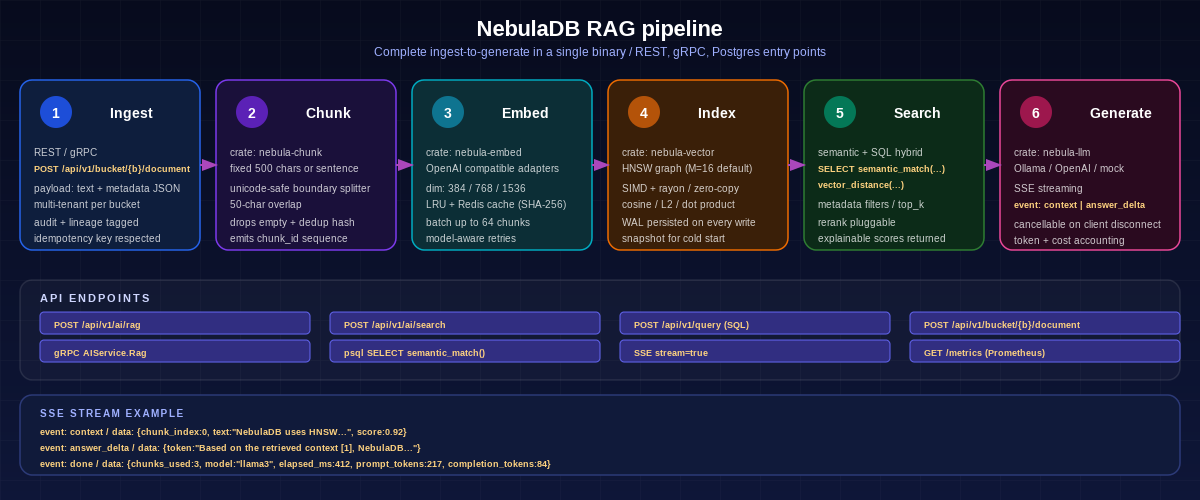
Managed platforms provide context retrieval — they return relevant chunks, but you must call an external LLM yourself. The pipeline is split across two services, adding latency and operational complexity.
Caching
NebulaDB's multi-tier embedding cache is a significant performance advantage:
- L1: In-process LRU — 10,000 entries by default, zero-copy retrieval
- L2: Redis — Optional distributed cache with SHA-256 keyed entries; failure-transparent (graceful degradation if Redis is down)
- SQL result cache — 512 entries with 30-second TTL, eliminating duplicate semantic retrieval
Cache keys use SHA-256(model || 0x00 || text) to prevent cross-model collisions. The batching layer partitions cache hits from misses in a single pass, minimizing upstream embedding API calls.
Managed platforms handle caching internally — you have no visibility into cache hit rates, no ability to tune cache sizes, and no control over eviction policies.
Durability
NebulaDB's Write-Ahead Log (WAL) provides crash-safe durability:
- 8-byte header per record (length + CRC32) with bincode encoding
- Segment rotation when files exceed configured size
- Vectors stored resolved — recovery does not require the embedder to be online
- Snapshot support for point-in-time recovery with zstd compression
- WAL compaction reclaims disk by rebuilding from snapshots
The leader/follower replication topology uses gRPC WAL subscription for cross-node synchronization, with follower write guards enforced at all three protocol layers (REST: 409, gRPC: FAILED_PRECONDITION, pgwire: SQLSTATE 25006).
Deployment and Operations
NebulaDB offers the most deployment flexibility:
- Single binary — Download and run
- Docker — Multi-arch images (linux/amd64 + linux/arm64) on Docker Hub, non-root user (UID 10001)
- Docker Compose — Full stack with Ollama, Redis, Prometheus, Grafana
- Helm Charts — Server, showcase UI, optional Redis subchart, ServiceMonitor for Prometheus Operator
- Kubernetes Operator — CRDs:
NebulaCluster,NebulaBucket,NebulaRebalance; admission webhooks; automated snapshot and WAL compaction before upgrades
Managed platforms are SaaS (multi-tenant) with enterprise self-host as an upsell tier. You trade deployment flexibility for operational convenience.
Observability
NebulaDB includes production-grade observability out of the box:
- Prometheus-compatible
/metricsendpoint - Pre-built Grafana dashboards in the Docker Compose stack
- Tracing integration (span-based via the tracing crate)
- SSE log stream at
/admin/logs/streamwith configurable level - Health check at
/healthzwith index statistics
Managed platforms do not publicly document their observability features. You are flying blind on cache performance, query latency distributions, and index health.
Cost
NebulaDB is free. Apache-2.0 licensed, self-hosted, no usage-based pricing, no seat limits, no feature gates. Your only cost is the infrastructure you run it on.
Managed platforms start at $249/month and scale to $5,000+/month. For a startup iterating on an AI product, that is $3,000-$60,000/year before you have written a line of application code.
API and Developer Experience
Document Ingestion (with auto-chunking)
curl -X POST http://localhost:8080/api/v1/bucket/knowledge/document \
  -H "Authorization: Bearer $NEBULA_API_KEY" \
  -H "Content-Type: application/json" \
  -d '{
    "doc_id": "arch-guide-001",
    "text": "NebulaDB uses HNSW for approximate nearest neighbor search...",
    "metadata": {"department": "engineering", "region": "eu-west-1"}
  }'
Semantic Search
curl -X POST http://localhost:8080/api/v1/ai/search \
  -H "Authorization: Bearer $NEBULA_API_KEY" \
  -H "Content-Type: application/json" \
  -d '{
    "query": "How does NebulaDB handle vector indexing?",
    "bucket": "knowledge",
    "top_k": 5
  }'
Streaming RAG
curl -N http://localhost:8080/api/v1/ai/rag \
  -H "Authorization: Bearer $NEBULA_API_KEY" \
  -H "Content-Type: application/json" \
  -d '{
    "query": "Explain the NebulaDB caching architecture",
    "bucket": "knowledge",
    "top_k": 3,
    "stream": true
  }'
SQL with AI Extensions (via psql)
psql -h localhost -p 5433

SELECT title, score FROM articles
WHERE semantic_match(content, 'Kubernetes deployment patterns')
  AND region = 'eu-west-1'
ORDER BY score DESC
LIMIT 10;
Use Case Mapping
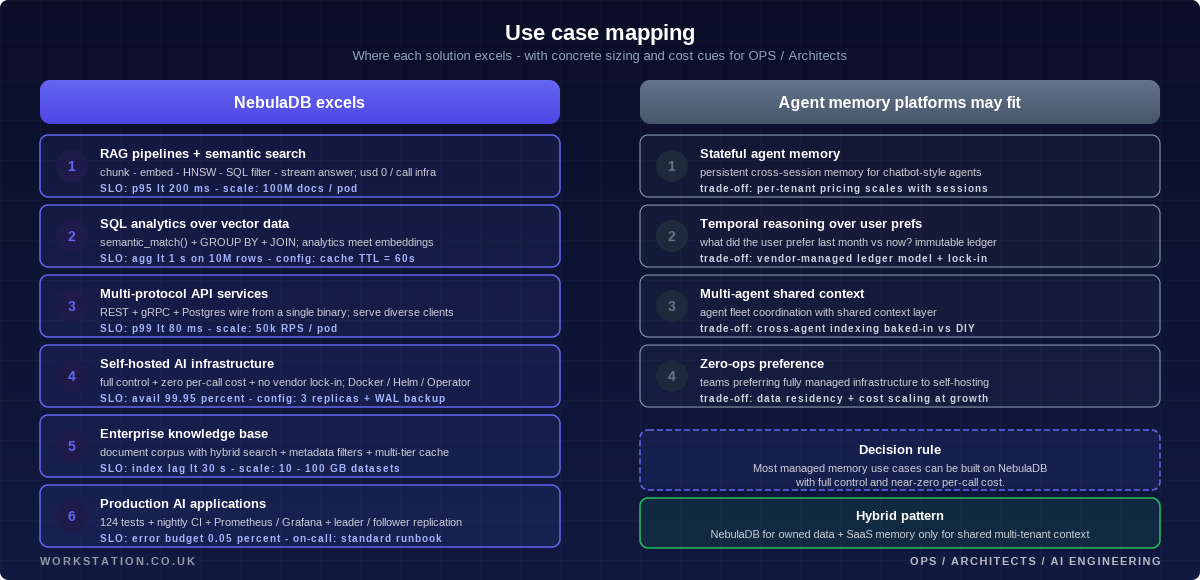
NebulaDB Excels For
- RAG Pipelines and Semantic Search — The complete ingest-to-generate pipeline in a single binary eliminates the need to stitch together separate embedding, indexing, and generation services.
- SQL Analytics Over Vector Data — No other solution lets you run
GROUP BY departmenton semantically retrieved documents. This unlocks analytics use cases that are impossible with retrieval-only platforms. - Multi-Protocol API Services — Teams with diverse client requirements (web frontend, microservices, data engineers) can use REST, gRPC, and Postgres wire protocol against the same index.
- Self-Hosted AI Infrastructure — Full control over data residency, security policies, and scaling. Zero vendor lock-in with Apache-2.0 licensing.
- Knowledge Base and Document Search — Enterprise document corpora with hybrid search combining semantic similarity and metadata filters.
- Production AI Applications — With 124 tests, nightly CI, multi-arch Docker images, Helm charts, a Kubernetes Operator, and Prometheus/Grafana observability, NebulaDB is production-ready.
Managed Platforms May Fit For
- Stateful Agent Memory — Persistent cross-session memory for chatbot-style AI agents where temporal state is the primary requirement.
- Temporal Reasoning — When "what did the user prefer last month?" is a core query pattern and an immutable ledger is non-negotiable.
- Multi-Agent Shared Context — Agent fleet coordination with built-in shared context layers.
- Zero-Ops Teams — Teams that prefer fully managed infrastructure and are willing to accept the cost and vendor lock-in trade-off.
It is worth noting that many managed platform use cases can also be built on NebulaDB — the WAL-based event replay provides temporal capabilities, and the extensible architecture supports custom agent memory layers.
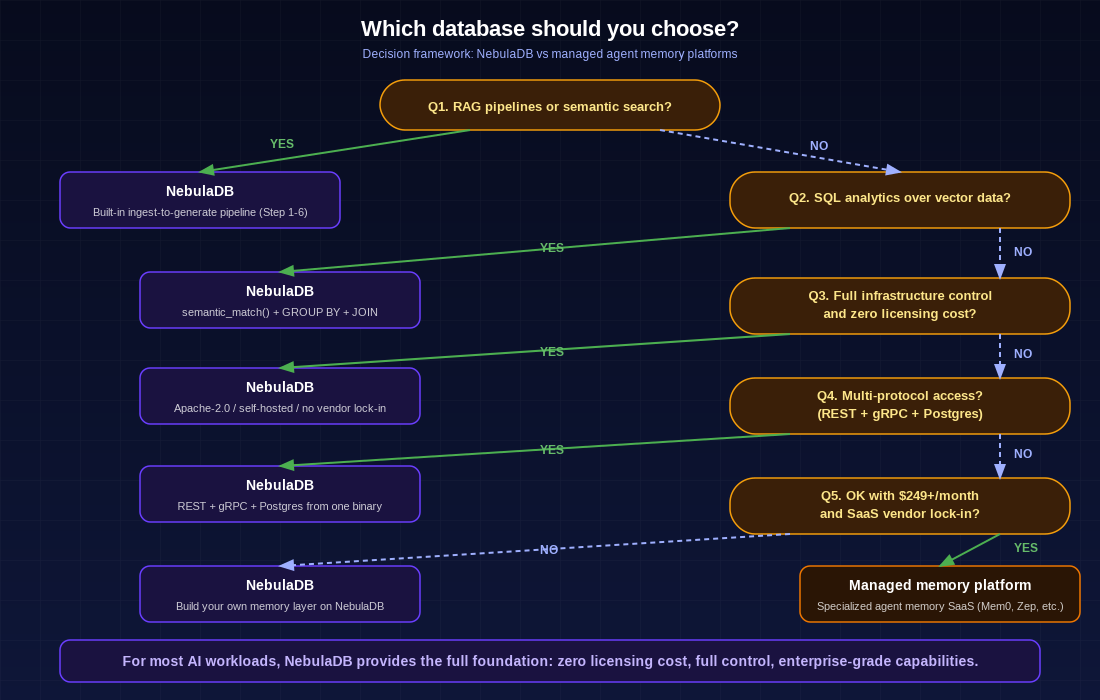
Decision Framework
Maturity and Production Readiness
NebulaDB demonstrates strong engineering practices:
- 124 unit tests across the workspace with Clippy-clean Rust stable
- Integration test suites covering REST CRUD, RAG streaming, pgwire SQL, Prometheus metrics, and load testing (60 concurrent requests, p95 < 750ms)
- Nightly CI at 02:00 UTC with configurable Ollama models
- Multi-arch Docker builds on main push and semver tags
- Property-based testing via proptest and benchmarks via Criterion
Managed platforms are generally early-stage SaaS with invite-based access, limited public documentation, and no observable CI or testing practices.
Conclusion
For the vast majority of AI workloads — RAG pipelines, semantic search, document retrieval, SQL analytics over embeddings, knowledge bases — NebulaDB delivers enterprise-grade capabilities at zero cost with full infrastructure control. Its Rust foundation ensures memory safety and performance. The three-protocol architecture means your entire organization can access the same data through their preferred interface. And the Kubernetes Operator, WAL durability, and Prometheus observability make it ready for production.
Agent memory platforms serve a narrower niche: teams building stateful conversational agents who need temporal reasoning out of the box and prefer to pay for managed infrastructure rather than operate their own. For those teams, the $249-$5,000+/month cost buys operational convenience at the expense of vendor lock-in, limited query capabilities, and opaque infrastructure.
For most teams building AI applications, NebulaDB is the clear choice. It is the complete foundation for AI-native data infrastructure — open-source, production-ready, and free.