An engineer's reading of NVIDIA's Vera Rubin datasheet: the seven chips, the five rack-scale systems of the Vera Rubin POD, the full specification tables, number formats, memory, NVLink and NVLink-C2C bandwidths, networking, power (MaxP, MaxQ, MaxLPS and DSX), 45°C liquid cooling, reliability and confidential computing, software, the NVL4 science results, the deployments NVIDIA has announced, and what a site needs before a Vera Rubin rack arrives.
This technote accompanies our page NVIDIA Vera Rubin: the systems, the specs and what your site needs and our blog post Vera Rubin for agentic AI data centres: which system, and how to get allocation. The main source is NVIDIA's Vera Rubin datasheet (dated October 2026), with NVIDIA's product pages, technical blog and press releases listed at the end. Every figure here is NVIDIA's own published specification or projection, not our measurement; NVIDIA marks many of them preliminary and subject to change, and we say where its documents disagree. Facts are as of 25 November 2026.
1. The Vera Rubin POD: five rack-scale systems
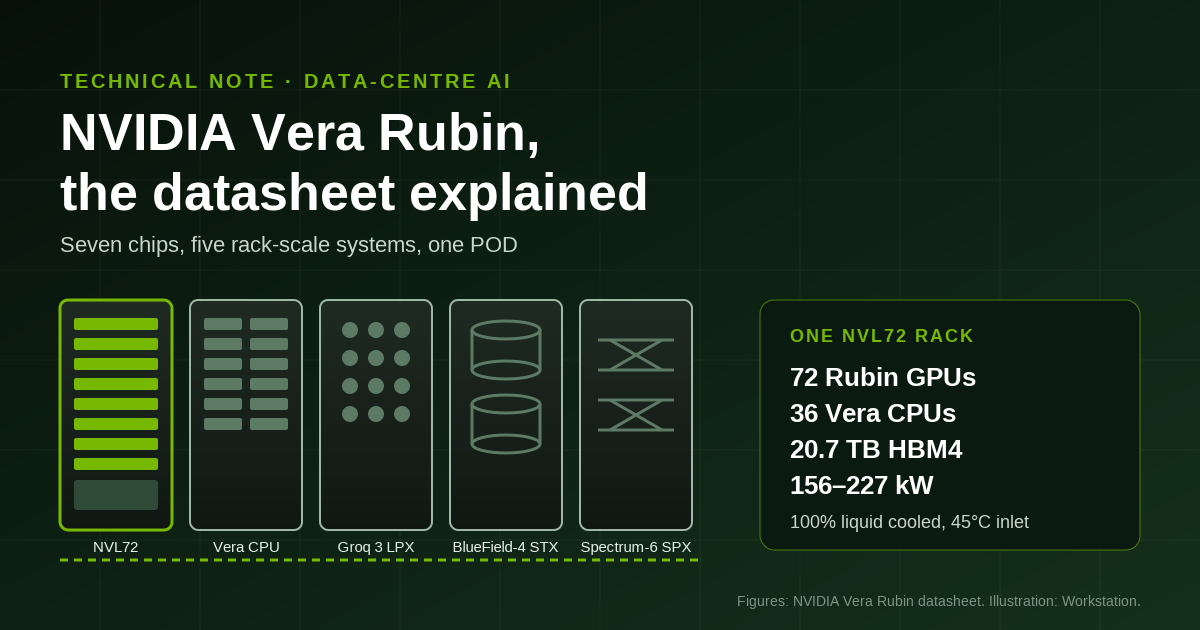
NVIDIA's technical blog describes the Vera Rubin POD as "seven chips, five rack-scale systems, one AI supercomputer". A full POD, as described there, is 40 racks with 1,152 Rubin GPUs, nearly 20,000 NVIDIA dies, 1.2 quadrillion transistors, 60 exaflops and 10 PB/s of total scale-up bandwidth. The five rack types are:
| Rack | What is in it | Its job in the POD |
|---|---|---|
| Vera Rubin NVL72 | 72 Rubin GPUs, 36 Vera CPUs, ConnectX-9 SuperNICs and BlueField-4 DPUs, joined by an NVLink 6 copper spine | Training (pretraining and post-training) and the compute-heavy parts of inference |
| Vera CPU rack | Up to 256 Vera CPUs, liquid cooled, on a Spectrum-X Ethernet spine | Agent sandboxes, reinforcement learning environments, tool calls, data processing |
| Groq 3 LPX | 256 Groq 3 LPUs in 32 trays of eight, on a direct chip-to-chip spine | Very low-latency token generation, paired with NVL72 |
| Vera BlueField-4 STX | BlueField-4 processors (Vera CPU plus ConnectX-9) on Spectrum-X Ethernet | AI-native storage, including CMX context memory for KV cache |
| Spectrum-6 SPX | Spectrum-X Ethernet or Quantum-X800 InfiniBand switches, with co-packaged optics | Rack-to-rack (east-west and north-south) networking for the whole POD |
The datasheet's "key offerings" are the systems a buyer actually orders: Vera Rubin NVL72, HGX Vera Rubin NVL8, HGX Rubin NVL8 and Vera Rubin NVL4. NVIDIA also sells its own DGX versions (DGX Vera Rubin NVL72 and DGX Rubin NVL8), and server makers build HGX and NVL72 systems under their own names. NVIDIA's press release names Dell Technologies, HPE, Lenovo and Supermicro, among many others, as being in full-scale production.
2. The seven chips
The datasheet's subtitle is "Seven new chips, one incredible AI supercomputer". Across the datasheet, the NVL72 product page and the POD blog, these are the chips that make up the platform:
2.1 Rubin GPU
Per GPU, NVIDIA lists 50 petaFLOPS of NVFP4 inference (sparse), 35 petaFLOPS of NVFP4 training and 17.5 petaFLOPS of FP8/FP6 training (dense), 4 petaFLOPS of FP16/BF16, 130 TFLOPS of FP32 and 33 TFLOPS of FP64, with 288 GB of HBM4. A new Transformer Engine uses hardware-accelerated adaptive compression to raise NVFP4 performance while, NVIDIA says, preserving accuracy, and it is fully compatible with Blackwell, so code already tuned for Blackwell moves across. The GPU has a second-generation RAS engine that runs health checks without taking the GPU offline.
2.2 Vera CPU
Vera has 88 custom NVIDIA Olympus cores (Arm compatible) with NVIDIA Spatial Multithreading, giving 176 threads with partitioned core resources. It has up to 1.5 TB of LPDDR5X on SOCAMM modules (detachable and field-replaceable) at up to 1.2 TB/s, a second-generation Scalable Coherency Fabric with 3.4 TB/s of bisection bandwidth on a single monolithic compute die, and NVLink-C2C at up to 1.8 TB/s of coherent bandwidth to the GPUs. It supports confidential computing. NVIDIA positions it both as the host CPU in NVL72 and HGX Vera Rubin NVL8 and as a standalone CPU for agentic and RL work, and claims up to 1.8x faster agentic sandbox performance and 80% faster agentic task completion than x86 processors, and 5x the memory bandwidth per watt and 3x the bandwidth per core of leading x86 CPUs with DDR5.
2.3 NVLink 6 switch
Sixth-generation NVLink joins the 72 GPUs of an NVL72 rack into one performance domain. The datasheet gives 3 TB/s per GPU and 216 TB/s per rack, double Blackwell. NVIDIA's later POD blog and HGX page give 3.6 TB/s per GPU and 260 TB/s per rack; treat the higher numbers as the newer preliminary figures. NVIDIA SHARP (Scalable Hierarchical Aggregation and Reduction Protocol), NVIDIA says, cuts network congestion for collective operations by up to 50%. An NVL72 rack has nine NVLink switch trays.
2.4 ConnectX-9 SuperNIC
The scale-out network adapter. Each NVL72 compute tray has eight ConnectX-9 SuperNICs; the DGX Vera Rubin NVL72 specification lists 144 single-port ConnectX-9 VPI ports at 800 Gb/s for InfiniBand or Ethernet.
2.5 BlueField-4 DPU
BlueField-4 combines a Vera CPU with a ConnectX-9 SuperNIC. Each NVL72 compute tray has one; DGX Vera Rubin NVL72 lists 18 dual-port BlueField-4 at 400 Gb/s. NVIDIA says it provides software-defined networking at up to 800 Gb/s with multi-tenant isolation, and with DOCA it enforces zero-trust policy, runtime threat detection and encryption in silicon without using host CPU time. BlueField-4 is also the processor in the STX storage rack.
2.6 Spectrum-6 Ethernet switch
Spectrum-6 is a 102.4 Tb/s switch with 512 lanes and 200 Gb/s co-packaged optics (CPO), in single- and multi-chip versions. Co-packaged optics replace pluggable transceivers. For Spectrum-X Ethernet Photonics, NVIDIA claims 5x better power efficiency, 5x longer AI uptime and 1.3x faster time to deployment than networks using traditional transceivers.
2.7 Groq 3 LPU
The language processing unit is the next generation of Groq's LPU. Each has 500 MB of on-chip SRAM, 150 TB/s of SRAM bandwidth and 2.5 TB/s of scale-up bandwidth. It keeps model data in SRAM rather than HBM, which is what makes token generation fast and predictable; it complements the Rubin GPU's large HBM rather than replacing it.
3. Rack-scale design: third-generation MGX
Every rack in the POD is a third-generation NVIDIA MGX rack: single-wide (19-inch), with a PCB midplane in place of internal cables, so compute and NVLink switch trays are modular, cable-free, hose-free and fanless. There are two families:
- MGX NVL, joined by an NVLink copper spine. In the NVL72 the spine is four pre-integrated cable cartridges holding about 5,000 copper cables, over two miles of cable in total.
- MGX ETL, joined either by a Spectrum-X Ethernet spine (used for the Vera CPU and STX racks, and configurable for up to 256 Rubin GPUs in HGX Rubin NVL8 systems) or by a direct chip-to-chip spine (used for LPX). In the Ethernet version, 1U Spectrum-6 switch trays sit in the middle of the rack, with rear ports on the spine and 32 front OSFP cages for optics to the rest of the POD.
Both families share racks, trays, cable cartridges, liquid-cooling manifolds, quick disconnects, busbars, power shelves and leak containment trays, so a site can plan for one rack envelope. NVIDIA contributed the MGX design to the Open Compute Project and cites more than 80 MGX ecosystem partners.
An NVL72 rack has 18 compute trays and 9 NVLink switch trays. Each compute tray holds two Vera Rubin Superchips (about 17,000 components each), with eight ConnectX-9 SuperNICs and one BlueField-4 DPU in front bays. The rack has about 1.3 million components and nearly 1,300 chips, and NVIDIA's blog puts its weight at roughly 4,000 lb (about 1.8 tonnes). On serviceability NVIDIA's numbers differ by document: the blog says compute tray assembly drops from nearly two hours to about five minutes (up to 20x faster), while the datasheet says up to 90x faster assembly than Blackwell.
4. Specifications
4.1 Vera Rubin NVL72, Superchip and NVL4
From the datasheet's technical specification table. Inference figures are sparse, training and other figures dense, and network bandwidth is bi-directional.
| Specification | Vera Rubin NVL72 | Vera Rubin Superchip | Vera Rubin NVL4 |
|---|---|---|---|
| Configuration | 72 Rubin GPUs, 36 Vera CPUs | 2 Rubin GPUs, 1 Vera CPU | 4 Rubin GPUs, 2 Vera CPUs |
| NVFP4 inference | 3,600 PFLOPS | 100 PFLOPS | 200 PFLOPS |
| NVFP4 training | 2,520 PFLOPS | 70 PFLOPS | 140 PFLOPS |
| FP8/FP6 training | 1,260 PFLOPS | 35 PFLOPS | 70 PFLOPS |
| FP16/BF16 | 288 PFLOPS | 8 PFLOPS | 16 PFLOPS |
| TF32 | 144 PFLOPS | 4 PFLOPS | 8 PFLOPS |
| FP32 | 9,360 TFLOPS | 260 TFLOPS | 520 TFLOPS |
| FP64 | 2,400 TFLOPS | 67 TFLOPS | 134 TFLOPS |
| GPU memory | bandwidth | 20.7 TB HBM4 | 1,400 TB/s | 576 GB HBM4 | 38.5 TB/s | 1.1 TB HBM4 | 77 TB/s |
| NVLink | Sixth generation, 216 TB/s | 6 TB/s | 12 TB/s |
| NVLink-C2C | 65 TB/s | 1.8 TB/s | 3.6 TB/s |
| CPU cores | 3,168 Olympus cores, 6,336 threads | 88 cores, 176 threads | 176 cores, 352 threads |
| CPU memory | Up to 54 TB LPDDR5X | Up to 1.5 TB LPDDR5X | Up to 3 TB LPDDR5X |
| Scale-out networking | 32.4 TB/s | 0.9 TB/s | 1 TB/s |
| NVIDIA + HBM4 chips | 1,296 | 30 | 60 |
| Power | MaxP 227 kW, MaxQ 187 kW, MaxLPS 156 kW | – | – |
| Inlet temperature | 45°C | ||
4.2 HGX Vera Rubin NVL8 and HGX Rubin NVL8
Both are eight Rubin SXM GPUs on an HGX baseboard. HGX Vera Rubin NVL8 adds a single-socket Vera CPU (88 cores, up to 1.5 TB of LPDDR5X); HGX Rubin NVL8 uses an x86 CPU board whose CPU and memory are set by the server maker.
| Specification (per 8-GPU system) | Datasheet | NVIDIA HGX page (later, preliminary) |
|---|---|---|
| NVFP4 inference (sparse) | 400 PFLOPS | 400 PFLOPS |
| NVFP4 training (dense) | 270 PFLOPS | 280 PFLOPS |
| FP8/FP6 training (dense) | 130 PFLOPS | 140 PFLOPS |
| FP16/BF16 | TF32 | 32 | 16 PFLOPS | 32 | 16 PFLOPS |
| FP32 | FP64 | 1,040 | 265 TFLOPS | 1,040 | 265 TFLOPS |
| GPU memory | bandwidth | 2 TB HBM4 | 130 TB/s | 2.3 TB HBM4 | 176 TB/s |
| NVLink Switch bandwidth | 24 TB/s | 28.8 TB/s |
| Networking bandwidth | 1.8 TB/s | 1.6 TB/s |
| Inlet temperature | 45°C | – |
The HGX page also lists per-GPU figures of 288 GB of HBM4 at 22 TB/s and 3.6 TB/s of NVLink, against 19.2 TB/s and 3 TB/s on the NVL72 product page. The direction of travel is upward; for a purchase, the figures on the server maker's final specification sheet are the ones that count. NVIDIA says HGX Rubin NVL8 delivers up to 10x the token throughput of HGX B200 (Kimi K2 Thinking, 4K/4K, first token within 500 ms, Rubin at sparse NVFP4 against B200 at dense NVFP4) and matches HGX B200's training with 4x fewer GPUs (DeepSeek-R1 pretrained on 15T tokens).
4.3 DGX systems
- DGX Vera Rubin NVL72 (preliminary): 72 Rubin GPUs and 36 Vera CPUs; 20.7 TB of GPU memory at up to 1,580 TB/s; 3,600 PFLOPS NVFP4 inference, 2,520 PFLOPS NVFP4 training and 1,260 PFLOPS FP8/FP6 training; 144 ConnectX-9 ports at 800 Gb/s and 18 dual-port BlueField-4 at 400 Gb/s; nine L1 NVLink switches; BMC with RJ45; Mission Control, AI Enterprise and DGX OS; three years of business-standard enterprise support.
- DGX Rubin NVL8: eight Rubin GPUs and two Intel Xeon 6776P processors; 2 TB of GPU memory at 130 TB/s; 400 PFLOPS NVFP4 inference (sparse), 270 PFLOPS NVFP4 training and 130 PFLOPS FP8/FP6 training (dense); 24 TB/s NVLink Switch bandwidth; about 24 kW; eight ConnectX-9 ports at up to 800 Gb/s and one BlueField-4 DPU; DGX OS, Ubuntu, Red Hat Enterprise Linux or Rocky. (The same page's feature text mentions 176 TB/s of memory bandwidth, so expect the table to be updated.)
4.4 A 100 MW AI factory
The datasheet also sizes an at-scale AI factory built with DSX and MaxLPS: 40,000 Rubin GPUs in 100 MW, giving 2 zettaFLOPS of NVFP4 inference, 1.4 zettaFLOPS of NVFP4 training, 700 exaFLOPS of FP8/FP6, 160 exaFLOPS of FP16/BF16 and 80 exaFLOPS of TF32, with 12 PB of HBM4 at 800 PB/s, up to 30 PB of LPDDR5X and up to 42 PB of fast memory. Our arithmetic: that is 2.5 kW of facility power per GPU, all in.
5. Number formats
The datasheet quotes NVFP4, FP8/FP6, FP16/BF16, TF32, FP32 and FP64, and the HGX page adds INT8 (2 POPS per 8-GPU system, 250 TOPS per GPU) and emulated FP32 SGEMM and FP64 DGEMM (3,200 and 1,600 TFLOPS per system using Tensor Core emulation).
- NVFP4 is the headline format for inference and, increasingly, training. NVIDIA quotes inference sparse and training dense, so 3,600 and 2,520 PFLOPS are not the same kind of number; compare like with like.
- FP8/FP6 is the mainstream training format; 1,260 PFLOPS dense per NVL72 rack.
- FP16/BF16 and TF32 remain for models and steps that need more range or precision.
- FP32 and FP64 matter for simulation and HPC. Rubin's native FP64 is 33 TFLOPS per GPU; the HGX page's emulated DGEMM figure is much higher, but emulation is a library technique, so check that your code path uses it before planning around it.
6. Memory
Vera Rubin has four memory tiers, and the platform is designed to move model state and KV cache between them:
- HBM4 on the GPU: 288 GB per Rubin GPU, 576 GB per Superchip, 20.7 TB per NVL72 rack.
- LPDDR5X on the CPU: up to 1.5 TB per Vera CPU and up to 54 TB per NVL72 rack, reachable from the GPUs over coherent NVLink-C2C. The datasheet's "fast-access memory" is the two added together: up to 75 TB per NVL72 rack and up to 4.1 TB per NVL4.
- CMX context memory on the BlueField-4 STX rack: a shared tier that stores KV cache so it can be reused across turns, sessions and agents. NVIDIA says up to 5x higher tokens per second and up to 5x better power efficiency than traditional storage approaches.
- SRAM on the LPU: 500 MB per LPU, 128 GB per LPX rack at 40 PB/s, backed by 12 TB of DDR5 per rack.
For capacity planning, start from the HBM: a model's weights plus the KV cache for your target context length and concurrency must fit in the NVLink domain's 20.7 TB, or spill to LPDDR5X and CMX at lower bandwidth.
7. NVLink, NVLink-C2C and scale-up
- GPU to GPU: 216 TB/s per NVL72 rack in the datasheet (3 TB/s per GPU); 260 TB/s (3.6 TB/s per GPU) in the later POD blog.
- CPU to GPU: NVLink-C2C at 1.8 TB/s per Vera CPU, 65 TB/s per rack, coherent, so the GPU can use CPU memory directly.
- Inside the CPU: Scalable Coherency Fabric at 3.4 TB/s bisection bandwidth.
- NVL4: four GPUs on a second-generation NVLink bridge running sixth-generation NVLink (12 TB/s), with two Vera CPUs over NVLink-C2C (3.6 TB/s).
- LPX: 640 TB/s of direct chip-to-chip scale-up bandwidth per rack, maintained across racks so several LPX racks act as one inference engine.
The roadmap in NVIDIA's blog: Vera Rubin Ultra NVL576 joins eight NVL racks of 72 Rubin Ultra GPUs into one 576-GPU NVLink domain, and the next-generation Kyber rack doubles the domain per rack to 144 GPUs (Vera Rubin Ultra NVL144) and scales to NVL1152. These are future products, not part of the current datasheet.
8. Networking
- Scale-out per NVL72 rack: 32.4 TB/s bi-directional, through ConnectX-9 SuperNICs at 800 Gb/s, on Quantum-X800 InfiniBand or Spectrum-X Ethernet.
- Per 8-GPU HGX system: 1.8 TB/s in the datasheet (1.6 TB/s on the HGX page).
- Front-end and security: BlueField-4 at up to 800 Gb/s with DOCA for isolation and encryption.
- Rack to rack: Spectrum-6 SPX racks with Spectrum-X Ethernet (including co-packaged optics) or Quantum-X800 InfiniBand. Inside MGX ETL racks, a Spectrum-X multiplane topology fans the 200 Gb/s lanes across several switches, giving all-to-all connectivity within the rack in a single network tier.
NVIDIA's press release names CoreWeave, Lambda and Oracle Cloud Infrastructure among the first adopters of its co-packaged optics networking.
9. Power: MaxP, MaxQ, MaxLPS and DSX
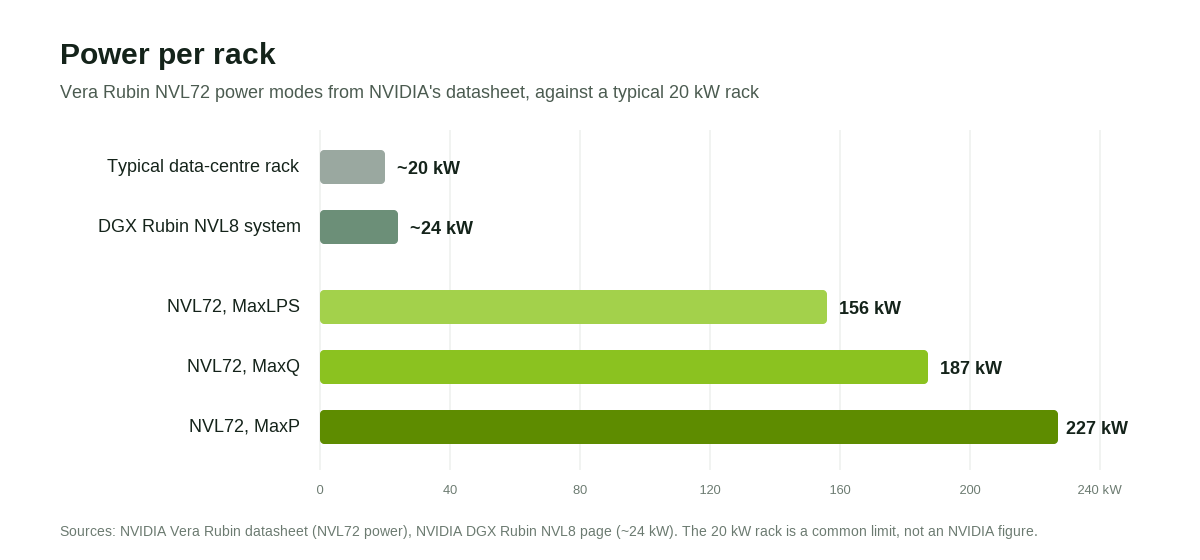
- MaxP, 227 kW per NVL72 rack: the full power the rack can draw. Provisioning every rack at MaxP assumes every workload always needs peak power, which NVIDIA says strands capacity.
- MaxQ, 187 kW: a lower, dynamic provisioning level. NVIDIA says it frees stranded power and allows up to 30% more GPUs in the same power budget with 45°C liquid cooling.
- MaxLPS, 156 kW: part of NVIDIA DSX. The datasheet describes it as a suite of chip, thermal, system and software technologies working on three layers: dynamic GPU power allocation to recover stranded power, software optimisation for performance per watt, and 45°C liquid cooling to improve PUE. The 100 MW, 40,000-GPU factory above assumes MaxLPS.
Inside the rack, dynamic power steering moves power between CPUs, GPUs and NVLink switch trays according to demand. Intelligent Power Smoothing adds 6x more rack-level energy storage than earlier generations (400 J per GPU) in capacitors that cushion the steep load swings of AI training; a closed loop lets the GPUs watch the capacitors' charge. NVIDIA says this reduces peak current demand by up to 25%, which matters to the utility and to your upstream electrical equipment.
NVIDIA Vera Rubin DSX is the AI factory reference design "from chip to grid": compute, networking, storage, power, cooling and facility controls designed together, with the Omniverse DSX Blueprint for digital twins of the factory. NVIDIA's press release lists Dell Technologies, HPE, Lenovo, Supermicro, ASUS, Foxconn, GIGABYTE, Pegatron, QCT, Wistron and Wiwynn as adopting DSX.
10. Cooling
- 100% liquid cooled, with new internal tray manifolds, UQD08 rack manifolds and liquid-cooled busbars supporting up to 5,000 A.
- 45°C (113°F) warm-water inlet on every MGX rack. NVIDIA's reference layout supplies 41°C facility water to the coolant distribution units (CDUs), which supply 45°C coolant to the racks.
- Free cooling: at 45°C, NVIDIA says many climates can use ambient air and closed-loop dry coolers instead of compressors, lowering PUE; it estimates the saving is enough for up to 10% more NVL72 racks in the same power budget. A 35°C inlet would divert much more facility power or water to cooling.
- Coolant: depends on the site; NVIDIA expects many to use de-ionised water or a propylene-glycol mix (PG25), which can last up to 10 years in a closed loop.
- Compatibility: NVIDIA says data centres already designed for liquid cooling can move to Vera Rubin without redesigning their cooling.
11. Reliability and confidential computing
- Second-generation RAS engine on the Rubin GPU for proactive maintenance and real-time health checks without downtime.
- Vera serviceability: SOCAMM LPDDR5X modules can be replaced, and the CPU runs in-system tests on its cores.
- NVLink resilience: switch trays can be put into maintenance mode and replaced while the rack keeps running, the rack can keep operating with several switch trays unavailable, and NVLink routing is software-defined.
- Third-generation Confidential Computing: one trusted execution environment across all 36 Vera CPUs, 72 Rubin GPUs and the NVLink fabric, with data encrypted across the interconnects and attestation services for cryptographic proof. NVIDIA's press release names CoreWeave, Firmus, GMI Cloud, IBM Cloud, IREN, Lambda, Microsoft Azure, Nebius, Nscale, SpaceXAI and Vultr as cloud providers adopting NVIDIA Confidential Computing.
12. Software
- NVIDIA Mission Control (optional): configuration, facility integration, cluster and workload management, and control over cooling and power events.
- NVIDIA AI Enterprise, including NIM microservices, for supported frameworks and model serving.
- DGX OS on DGX systems; DGX Rubin NVL8 also lists Ubuntu, Red Hat Enterprise Linux and Rocky.
- DOCA on BlueField-4 for network isolation, zero-trust policy and encryption.
- NVIDIA OpenShell reference architecture for safe AI agents, combining the OpenShell runtime, Vera CPUs, Vera Rubin systems and NVIDIA Sentry on BlueField-4.
- Compatibility: the Transformer Engine is compatible with Blackwell, so Blackwell-optimised code is expected to move across.
13. NVIDIA's performance claims, with their conditions
| Claim (NVIDIA) | Compared with | Conditions NVIDIA states |
|---|---|---|
| One-tenth the cost per million tokens | GB200 NVL72 | Kimi K2 Thinking, 32K input / 8K output; subject to change |
| Up to 10x more tokens per megawatt | GB200 NVL72 | Kimi K2 Thinking, 32K/8K |
| MoE training with one-quarter the GPUs | GB200 NVL72 | 10T-parameter MoE trained on 100T tokens in one month; projected |
| Up to 35x higher throughput per megawatt | Blackwell | NVL72 paired with LPX; models from 235B to 2T parameters with 32K–400K KV-cached tokens; projected |
| 10x agent throughput at scale | Grace Blackwell | Press release, POD scale |
| Up to 10x token throughput; training with 4x fewer GPUs | HGX B200 | HGX Rubin NVL8; Kimi K2 Thinking 4K/4K; DeepSeek-R1 15T tokens; projected |
None of these are independent benchmarks. When you size a system, run your own model, context length and serving stack, or ask us for a sizing based on them.
14. Vera Rubin NVL4 for science
NVL4 is four Rubin GPUs and two Vera CPUs, for liquid-cooled MGX servers. The datasheet projects its performance against GH200 CG4 (four Grace Hopper Superchips). NVIDIA's assumptions: CG4 with 200 Gb/s of network and 700 W per GPU; NVL4 with 800 Gb/s and 1,800 W per GPU. So part of the gain comes from a larger power and network budget per GPU.
| Workload | Field | NVL4 vs GH200 CG4 (projected) |
|---|---|---|
| Star-CCM+ | Computational fluid dynamics | 3x |
| HemeLB (blood-flow simulation) | Computational fluid dynamics | 4x |
| RTM (reverse time migration) | Oil and gas seismic imaging | 3x |
| FWI (full waveform inversion) | Oil and gas seismic imaging | 4x |
| GPT-3 175B training (FP8) | AI for science, training | 6x |
| Llama 3.1 405B training (FP8) | AI for science, training | 6x |
| AlphaFold (BF16) | AI for science | 4x |
| Llama 2 70B inference (NVFP4) | AI for science, inference | 8x |
The 1,800 W per GPU in NVIDIA's NVL4 assumptions is also a useful planning number for servers built around it.
15. Real-world deployments
Only deployments named in NVIDIA's own materials are listed here.
- Japan's national AI factory (Noetra). On 16 July 2026 NVIDIA announced it is working with Noetra Corp. on a Vera Rubin AI factory with 13,750 Vera CPUs and 27,500 Rubin GPUs, delivering 140 MW of data-centre capacity on the DSX platform. It is built from Vera Rubin NVL72 racks with Spectrum-X Ethernet and BlueField DPUs, is supported by Japan's Ministry of Economy, Trade and Industry (METI), and will be the computing foundation for the FRONTia project, which develops open multimodal foundation models for AI agents, digital twins, robotics and physical AI. (Our arithmetic: 27,500 GPUs is about 382 NVL72 racks' worth, and 140 MW is about 5.1 kW of facility capacity per GPU.)
- Full production. On 31 May 2026 NVIDIA announced Vera Rubin was ramping into full production, with Taiwan's server makers and the wider supply chain (hundreds of partners, 150 in Taiwan alone, across more than 350 factories in 30 countries) building systems for AI labs, cloud providers and hyperscalers; production shipments were set to begin in the autumn. NVIDIA's NVL72 page now says Vera Rubin-based systems are shipping.
- Vera CPUs at AI labs. NVIDIA's Vera page reports the first Vera CPU systems were hand-delivered to Anthropic, OpenAI, Oracle Cloud Infrastructure and SpaceXAI, and that Perplexity is adopting Vera. NVIDIA also uses Vera for its own chip design, reporting up to 1.5x higher performance on verification and simulation work in early tests.
- Cloud providers adopting Vera Rubin's confidential computing, and early adopters of co-packaged optics networking, are listed in sections 8 and 11.
Typical workloads (our summary, not named deployments)
- Agentic AI: many agents that plan, call tools and run code. NVL72 (or NVL72 plus LPX) generates the tokens; Vera CPU racks run the sandboxes and tool calls; STX keeps their context.
- Long-context inference: million-token contexts and long agent sessions, where the KV cache dominates memory. HBM4, LPDDR5X over NVLink-C2C and CMX are the relevant tiers.
- Mixture-of-experts training: the 72-GPU NVLink domain keeps expert traffic inside the rack; NVIDIA's one-quarter-the-GPUs claim is for a 10T-parameter MoE model.
- Reinforcement learning and post-training: GPU training loops fed by thousands of CPU-side environments, the case for Vera CPU racks.
- AI for science and HPC: simulation plus AI models in one node, the case for NVL4.
- Enterprise 8-GPU servers: HGX or DGX Rubin NVL8 where a full NVL72 rack is too much power or capacity.
16. Planning a Vera Rubin deployment
- Power per rack. Budget about 187 to 227 kW per NVL72 rack (156 kW with MaxLPS), and about 24 kW per DGX Rubin NVL8. Many existing data centres allow around 20 kW per rack, so most Vera Rubin projects need a purpose-built or upgraded hall. Ask your utility and electrical designer about load swings; Intelligent Power Smoothing helps but does not remove the need to plan for it.
- Liquid cooling. CDUs, a warm-water loop that can supply 45°C coolant, manifolds and leak containment. Decide the coolant (de-ionised water or PG25) and the heat-rejection plant; at 45°C, dry coolers may be enough in your climate.
- Floor and logistics. Roughly 4,000 lb (about 1.8 tonnes) per NVL72 rack, single-wide 19-inch. Check floor loading, lift and door sizes, and the delivery route.
- Network and storage. Plan the scale-out fabric (InfiniBand or Spectrum-X Ethernet), the front-end network and storage, including KV-cache storage if you serve long contexts.
- CPU capacity for agents. If you run agents or RL, size the sandbox capacity too: NVIDIA says one Vera CPU rack runs more than 22,500 environments.
- Software and operations. Decide on Mission Control, AI Enterprise and your scheduler, and who runs the cluster day to day.
- Lead times on request. Vera Rubin is allocated by NVIDIA and the system makers. We don't publish stock or dates: we confirm price, allocation and delivery with our suppliers on a written quote.
- Compliance. These GPUs are export-controlled. Suppliers need the end user, the install site, the use and the company details before confirming stock. Our guide NVIDIA compliance: what we need from you explains the four stages.
Where to go next
- The overview: NVIDIA Vera Rubin: the systems, the specs and what your site needs.
- The buyer's view: Vera Rubin for agentic AI data centres: which system, and how to get allocation.
- Request a quote: search our shop for Vera Rubin, or ask our AI sales engineer.
Sources
- NVIDIA Vera Rubin datasheet (PDF)
- NVIDIA Rubin platform page
- NVIDIA Vera Rubin NVL72
- NVIDIA DGX Vera Rubin NVL72
- NVIDIA DGX Rubin NVL8
- NVIDIA HGX platform (HGX Rubin NVL8 and HGX Vera Rubin NVL8)
- NVIDIA Vera CPU
- NVIDIA Groq 3 LPX
- NVIDIA STX
- NVIDIA technical blog: NVIDIA Vera Rubin POD: seven chips, five rack-scale systems, one AI supercomputer (16 March 2026)
- NVIDIA press release: Vera Rubin ramps into full production (31 May 2026)
- NVIDIA press release: Japan government, industrial leaders and NVIDIA launch the world's first national AI infrastructure (16 July 2026)
Figures are NVIDIA's published specifications and projections, many preliminary and subject to change. NVIDIA, Vera Rubin, DGX, HGX, MGX, NVLink, BlueField, ConnectX, Spectrum-X and DSX are trademarks of NVIDIA Corporation. This note is independent and not endorsed by NVIDIA.