A loja já está disponível

Construímos máquinas Workstation AI para websites, agentes de IA e treino de LLM – configure e compre online.

Obter preços para revendedores
Produtos de IA
Laboratórios de IAAgentes OpenAIAgentes ClaudeBot GrokCRM nativo de IA Workstation AIMarketingTodos os produtos
Soluções de IA
IA aplicadaAgentes de IAIA generativaAutomação com IAFormação em IAPacotes de IA para PMELaboratório de IA empresarialWorkstations de IAHardware e software NVIDIAComputação acelerada NVIDIAIA privadaCloud privada de GPUClusters de GPUIA na edgeIA por setor
Serviços de IA
Modernização de plataformasEngenharia digitalFundações de dados e IAOperações autónomasConsultoria de IAAutomação DevOpsCibersegurançaDesenvolvimento de softwareCriação de agentesConfiguração de MLOpsLeasing de GPUCloud privada de GPU
Sobre nós
EmpresaA nossa históriaParceirosHistórias de clientes
Centros de dados de IA
Centros de dados de IACloud privada de GPUClusters de GPULeasing de GPU
Perspetivas sobre IASérie JevLaboratório de benchmarksSeleção de modelos
Notas técnicas
Documentação
Sistema operativo LinuxUbuntuRed Hat Enterprise LinuxSUSE LinuxAlpine LinuxDebian, Rocky e AlmaLinux
Plataformas de IA na cloudAWS e Amazon BedrockGoogle Cloud e Vertex AIMicrosoft Azure e AI FoundryClouds de GPU e marketplaces
Centros de dados de IA privadosPara escritórios de advogadosPara empresas de contabilidadePlataformas on-premisesCloud totalmente protegida
FerramentasRing PromoterJobshout
Notícias
Blogue
Contacte-nosIniciar sessão

Workstations de IA, software de IA multiagente, infraestrutura de GPU e soluções de agentes inteligentes para empresas modernas.

Contacte-nos

Soluções de IA

IA aplicadaAgentes de IAIA generativaAutomação com IAFormação em IAPacotes de IA para PMELaboratório de IA empresarialIA por setor

Produtos

Todos os produtosCRM e ERP nativos de IA Workstation AIMarketingAgentes OpenAIRing PromoterJobshout

Empresa

Sobre nósEmpresaCentros de dados de IAPorquê a WorkstationParceirosHistórias de clientesPreçosContactoTenthMatrix

Recursos

Perspetivas sobre IANotas técnicasDocumentaçãoSistema operativo LinuxPlataformas de IA na cloudCentros de dados de IA privadosBloguePesquisarMapa do site
Escritório na Bélgica
Workstation SRL, Rue Vanderkindere 34, 1180 Uccle, BrusselsBE 0751.518.683Seg – Sex: 9h00 – 18h00 CET
+32 492 45 67 46
Sede no Reino Unido
77-79 Marlowes, Hemel Hempstead HP1 1LFIndicações – saia na junção 20 da M25 (Outer London)N.º de registo da empresa: 11641870Seg – Sex: 9h00 – 18h00 GMT
+44 7515 356 146
Escritório na Índia
#159 Sector 9, Pocket 1, DDA Flats, 110077 Dwarka, New Delhi
+91 98881 98841
Escritório em Taiwan
3F, No. 2-4, Aisi Rd., Ren'ai Dist., Keelung City 200, Taiwan基隆市仁愛區愛四路2之4號3樓Seg – Sex: 9h00 – 18h00, hora de Taiwan (GMT+8)
+886 926 892 701+32 492 45 67 46
Escritório na Estónia
Aleksander Puškini tn 30-25, 20306 Narva, EstoniaSeg - Sex: 9h00 - 18h00, hora da Estónia (EET)
+32 492 45 67 46

© 2000-2026 Balinder Singh Walia. Todos os direitos reservados.

O sítio web Workstation e todo o seu conteúdo, bem como as APIs e plugins associados, são protegidos por direitos de autor de Balinder Singh Walia. balinder.walia@gmail.com

PrivacidadeEliminação de dadosCookiesTermos de serviçoMapa do site

NVIDIA, o logótipo NVIDIA, RTX, RTX PRO, Blackwell, CUDA, NVLink, MGX, Omniverse, Spectrum-X, Quantum, BlueField, DGX e HGX são marcas comerciais e/ou marcas registadas da NVIDIA Corporation nos EUA e noutros países. AMD, o logótipo AMD Arrow, EPYC, Instinct, Ryzen e Threadripper são marcas comerciais da Advanced Micro Devices, Inc. Dell e PowerEdge são marcas comerciais da Dell Inc. ou das suas subsidiárias. Intel e Xeon são marcas comerciais da Intel Corporation ou das suas subsidiárias. AMAX, AceleMax e LiquidMax são marcas comerciais da AMAX Engineering Corporation. Todos os outros nomes de produtos, logótipos e marcas são propriedade dos respetivos proprietários. Utilizamo-los apenas para identificar os produtos que descrevemos, fornecemos ou suportamos; a sua utilização não significa que os respetivos proprietários nos recomendem.

Loading blog...

Início / Blogues
AILLMMLOpsObservabilityFinOpsAI AgentsOpentelemetryPrometheus

Uncovering LLM Bottlenecks: Observability, OTEL & Cost Control

Business brief: OpenTelemetry, Prometheus/Grafana, Langfuse — pros, cons, costs, and usage metrics that cut agent spend

Balinder Walia4 de setembro de 20264 min read
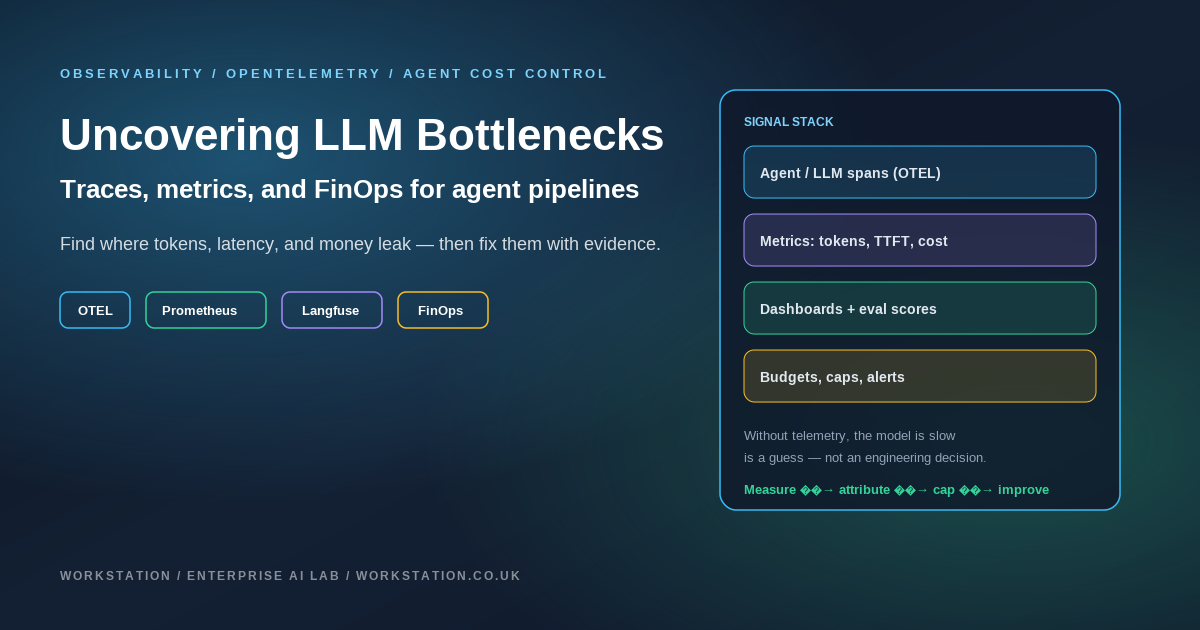
Uncovering LLM bottlenecks with OpenTelemetry and cost control

Workstation business brief: uncover LLM and agent bottlenecks with observability — OpenTelemetry, Prometheus/Grafana/Thanos, and LLM platforms such as Langfuse — so you can cut cost, tighten SLOs, and ship agents with evidence. Deep dive: long technical article (OTEL, FinOps, agent budgets). Related: Turbocharging LLMs · Enterprise AI Lab.

Uncovering LLM bottlenecks with OpenTelemetry and cost control

Bottom line. Most “slow AI” tickets are not mysterious model failures — they are missing attribution. Instrument agent runs with OpenTelemetry, score outputs, tag every call with tenant / model / route / tokens / cost, and enforce budgets. Teams that do this typically find 20–50% waste in retries, oversized models, and uncached prompts within the first measurement cycle.

Why bottlenecks hide without telemetry

LLM agents chain prompts, tools, RAG retrieval, and retries. Latency and spend compound across hops. Without spans and metrics you cannot tell whether the bottleneck is the model, the vector store, a flaky tool, or an unbounded self-debug loop. Business stakeholders then over-buy GPUs or API quotas while product quality stays flat.

Workstation’s stance for AI estates: treat agent pipelines like any other production service — observability first, then optimise serving (see PagedAttention / vLLM), then promote with discipline (Ring Promoter).

The observability stack that pays for itself
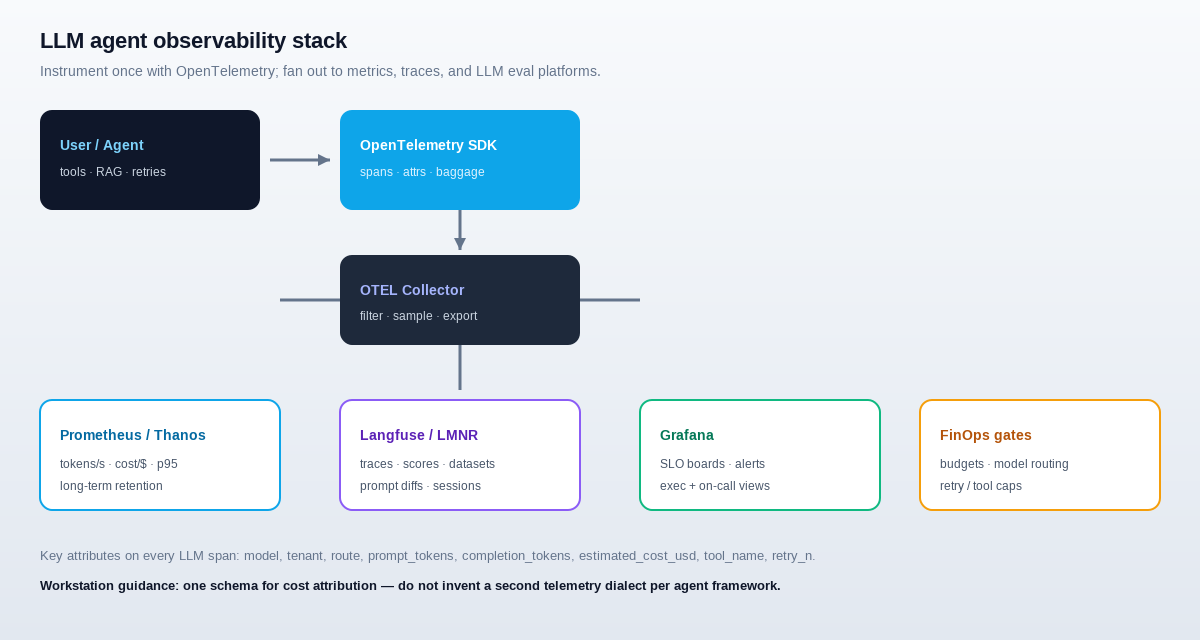
OpenTelemetry to Prometheus, Langfuse, Grafana, and FinOps gates

  • OpenTelemetry (OTEL) — one instrumentation layer for traces, metrics, and (where useful) logs. Export to a collector; fan out to backends.
  • Prometheus + Grafana (+ Thanos) — golden signals: request rate, error rate, latency, token throughput, estimated $/request, GPU utilisation. Thanos (or equivalent) keeps long-term metrics for FinOps reviews.
  • LLM observability platforms (e.g. Langfuse, LMNR) — session/trace UI, prompt versions, human & automated scores, datasets for regression.

Pros and cons of this approach

Dimension Pros Cons / trade-offs
Cost control Attribute spend to tenant, feature, model, and agent step; kill wasteful retries. Engineering time to instrument; storage cost for traces if retention is naive.
Quality Scores + datasets catch prompt regressions before customers do. Automated scoring can be noisy; humans still needed for critical paths.
Ops Same OTEL/Prometheus skill set as your other microservices. LLM-specific UIs (Langfuse etc.) add another product to run or buy.
Compliance Audit who called which model with which prompt version. Prompt/PII retention policies must be designed up front.
Speed to value First dashboards in days if you already run Grafana. Full cost attribution across multi-agent graphs takes longer.

Costs: what you spend vs what you save

Instrumentation cost (typical mid-size agent platform):

  • 1–2 engineer-weeks to adopt OTEL span conventions + exporter wiring.
  • Collector + metrics retention: often <5–10% of monthly LLM API/GPU spend once sampling is tuned.
  • Optional SaaS LLM observability: priced per event/trace — budget it as a % of model spend, not as an afterthought.

Savings levers (usage metrics that move the needle):

  • Tokens per successful task — not tokens per raw call. Cap tool loops and self-debug rounds.
  • Cost per successful task — route cheap models for classify/route; reserve frontier models for hard steps.
  • Cache hit rate — prompt/prefix caching where safe; measure correctness, not only latency.
  • Retry rate & dead-letter rate — flaky tools masquerade as “model quality” issues.
  • p95 TTFT and end-to-end latency — protect UX while you cut spend.
Rule of thumb. If you cannot answer “what did this agent cost last week by customer and by step?” you are not ready to scale usage — you are ready to surprise Finance.

Scoring: manual vs automatic

Method When to use Business note
Manual scoring Gold sets, regulated answers, brand-sensitive copy. Expensive but grounds automated judges.
Automatic scoring High-volume regression, LLM-as-judge, rubric checks. Cheap at scale; calibrate against humans monthly.

Migration playbook (start small)

  1. Instrument one production agent path end-to-end with OTEL + token/cost attributes.
  2. Ship a Grafana board for rate / errors / latency / $/success.
  3. Add Langfuse (or equivalent) for prompt versions and scores on that path.
  4. Enforce hard caps: max tokens, max tool calls, max retries per session.
  5. Expand to the next agent only after the first path shows a measured cost or latency win.

Watch: why observability matters for AI systems

Context talk on observability culture — not a Workstation product demo. Pair with OpenTelemetry docs and the Workstation technical article.

Read next

  1. Long article — OTEL span schema, collectors, cost formulas, agent caps, Langfuse/LMNR notes.
  2. Turbocharging LLMs — serving-side bottlenecks after you can see them.
  3. Local agents · Enterprise AI Lab · Contact Workstation

Published by Workstation. References: langfuse/langfuse · lmnr-ai/lmnr · OpenTelemetry.